About our family's dairy farm
Farm Facts at a Glance
Total Animals (Cows/Heifers): 400 (200/200)
Milkings per day: 2
Rolling Herd Average: 18,000 pounds
Milkng Parlor: Germania Model "B" double 10, rapid-exit Herringbone
Workforce: 4
Acres of pasture & forage production: 600
Hay/Silage forages: bermudagrass, corn, pearl millet, ryegrass, small grains
Primary pasture grasses: bermudagrass, tall fescue
Our Farm's History
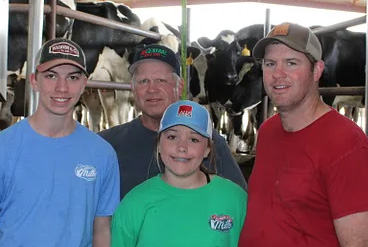
The Gilmer family has been farming for over 100 years in the Shiloh community in Lamar County, Alabama. The original farmstead was established when George F. Gilmer purchased the property from his father-in-law, Evans Jackson. He and his wife built their home and began farming in the style typical of the times. They planted cotton as a cash crop, raised livestock, and grew a variety of food crops to feed their family and the animals.
Gray Gilmer, the youngest of the family's nine children, worked through the Great Depression and World War II building dams for the TVA. He then worked as a safety engineer for USF&G Insurance before returning home in 1951 following his parents' passing. Like his father, he ran a diversified family farm, but the dairy operation quickly became his main focus. He spent the next thirty years cementing his reputation as a successful, hard working dairyman and community leader.
Gray's son, David Gilmer, returned to the dairy farm after graduating from Mississippi State University. Gray retired shortly thereafter, and David assumed the farm's ownership and management responsibilities. He spent the next two decades increasing the herd's size and production, incorporating minimal-till cropping practices, and improving efficiency. David is still fully engaged in the farm's daily labor and management, and his wife, Lin, serves as the farm's financial secretary.
Like his father, Will Gilmer returned to live and work on the farm following his graduation from MSU. He is now a partner with David in Gilmer Dairy Farm, LLC, and shares in the operation's day-to-day management and labor responsibilities. Will keeps the herd, crop, and fertilizer records, and maintains the farm website and social media channels.
Animal Care Practices
Our milking cows spend most of their time on pasture/drylot. Our primary bermudagrass pasture for the milking herd includes access to shade, water troughs, and a feeding area the cows can enter and exit free-choice. They also have access to two shade barns equipped with fans, misters, and water troughs that help cool them during the summer. The cows are regularly examined by a veterinarian and are observed daily for signs of potential sickness or lameness. When a problem arises, we take appropriate action to restore the cow's health and comfort. A dairy nutritionist formulates a balanced total-mixed-ration (TMR) diet comprised of forages, grain products, and vitamins for our cows. We supplement their TMR with seasonal grazing in other pastures adjacent to our milking facility.
Heifers and dry cows are kept in pastures large enough to support grazing. These animals also receive dairy feed daily and hay as needed to supplement grazing. Heifers are not bred until they are at least 14 months old and have the proper body size and structure to safely carry a calf from conception to birth. Our heifers are bred to "calving-ease" bulls whose offspring tend to be smaller than the breed average at birth, thus decreasing the potential for complications during the heifer's labor and delivery.
Sustainability
We don't just work the land...we live on it too! We do our best to protect our soil and water to provide a good home for our cows and for ourselves. We also like to provide "good scenery" for our neighbors as they drive by the farm. By using erosion control techniques such as no-till cropping, residue management, and buffer strips, we maximize the soil's ability to produce quality pasture and forages year after year.
We manage our dairy waste in an environmentally friendly manner using a 300,000 gallon glass-fused steel tank for storage/containment. We follow an NRCS-developed Comprehensive Nutrient Management Plan that allows us to utilize the stored waste as fertilizer, thereby decreasing our need for commercially manufactured fertilizers. The waste is field-applied via honeywagon in rates determined by soil conditions and crop nutrient requirements.
Gilmer Dairy Farm is a participant in the Farmers Assuring Responsible Management program. The National Dairy FARM Program was created to proactively address the concerns of consumers, retailers and processors who are interested in how food is produced. This on-farm audit assesses areas including animal care and wellness, environmental stewardship, employee training, and milk safety and quality.